


 By ROY XU
  November 12,2025
Cryogenic testing tells you if a valve will hold up when temperatures drop way below freezing. We’re talking about fluids like LNG and liquid oxygen running at -150°C or colder. Regular valves can’t handle that kind of cold and are prone to cracking and leaking. Testing helps you identify these issues before you proceed with the installation.
Cryogenic testing shows how a valve performs when it’s pushed into extreme cold. Liquid nitrogen cools the valve to about –196°C, and from there technicians look for leaks inside the valve and around the body. Tools like sniffers and manometers help them see how the valve holds up under those conditions.
At these temperatures, materials don’t behave the same way. Metals lose toughness, seals can shrink, and the whole valve contracts. A valve that works well at room temperature can leak or even crack when you run LNG or other cryogenic fluids through it. The test helps you see these issues before the valve goes into service.
Cryogenic valves carry fluids like LNG, liquid oxygen, and liquid nitrogen under extreme conditions. A leak in these systems creates serious safety hazards including explosions, asphyxiation, and environmental damage. Room-temperature testing alone won’t catch problems that only show up at -196°C.
Industry data shows that over 60% of valves fail basic quality tests for cryogenic service. Common failures include seal leakage, shell cracks, and stem packing problems that only appear at low temperatures.
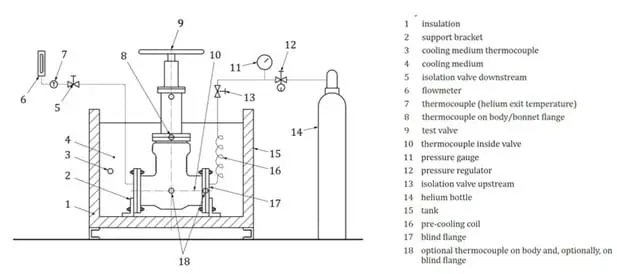
Three standard tests verify that a valve can handle cryogenic service:
Shell Strength Test: This test confirms the valve body can withstand operating pressure. The valve is mounted partially open and subjected to hydrostatic pressure according to API STD 598. Test pressure varies based on valve material and pressure class.
Seat Leak Test: This low-temperature valve leak test checks how well the valve seals under pressure. The valve is fully closed and hydrostatic pressure is applied through one port while technicians measure leakage at the other port. Test procedures follow ASME B16.34 and API STD 598 standards.
Cryogenic Production Test: This test uses actual cryogenic temperatures to verify performance. Liquid nitrogen is slowly introduced into the valve while it sits in a cryogenic tank. Once the valve reaches test temperature and pressure, technicians check for both internal and external leaks. This test follows BS 6364 standards specifically written for cryogenic valve testing.
Meeting cryogenic valve certification requirements means following established industry standards:
ISO 21011:2008 applies to all cryogenic valves except pressure relief valves, which fall under separate standards. When writing specifications, reference these standards explicitly. Manufacturers won’t apply cryogenic testing unless you ask for it.
Follow these practices when specifying valves for cryogenic service:
Include minimum temperature, maximum pressure, and the specific fluid being handled. Different cryogenic fluids have different requirements.
Documentation should include:
Not all valve manufacturers can perform legitimate cryogenic testing. Ask about their test equipment, procedures, and quality control processes.
For critical applications, have your inspector or a third-party inspector present during cryogenic valve test methods to verify tests are performed correctly.
Your purchase order should state which standards apply and what test documentation you expect to receive. Generic statements about “cryogenic testing” won’t protect you if the valve fails.
Cryogenic testing of valves prevents failures that could cause explosions, leaks, and shutdowns in LNG other low-temperature systems. The three main cryogenic valve test methods verify valves can handle extreme conditions. Specify testing standards explicitly and require documentation to ensure proper cryogenic valve certification.While YOUFUMI specializes in lined valves for corrosive media applications, we understand the importance of rigorous testing across all valve types. Our lined butterfly valves and lined ball valves undergo comprehensive quality testing to meet API 608, ASME B16.10, and API 598 standards for chemical processing applications.
See how YOUFUMI delivers precision-engineered valves with cutting-edge technology.
Learn About Our Process

Address:No. 1-1 Qianjie Street,Yongzhong High-Tech Zone, Longwan District, Wenzhou City, Zhejiang Province, China


 English
 Español
 Deutsch
 Français
 Русский
 العربية
 日本語
日本語 한국어
한국어 Português
 Italiano
 ไทย
ไทย Tiếng Việt
 Polski
 Türkçe
 Bahasa Indonesia
 فارسی
فارسی


 Technical Guide